
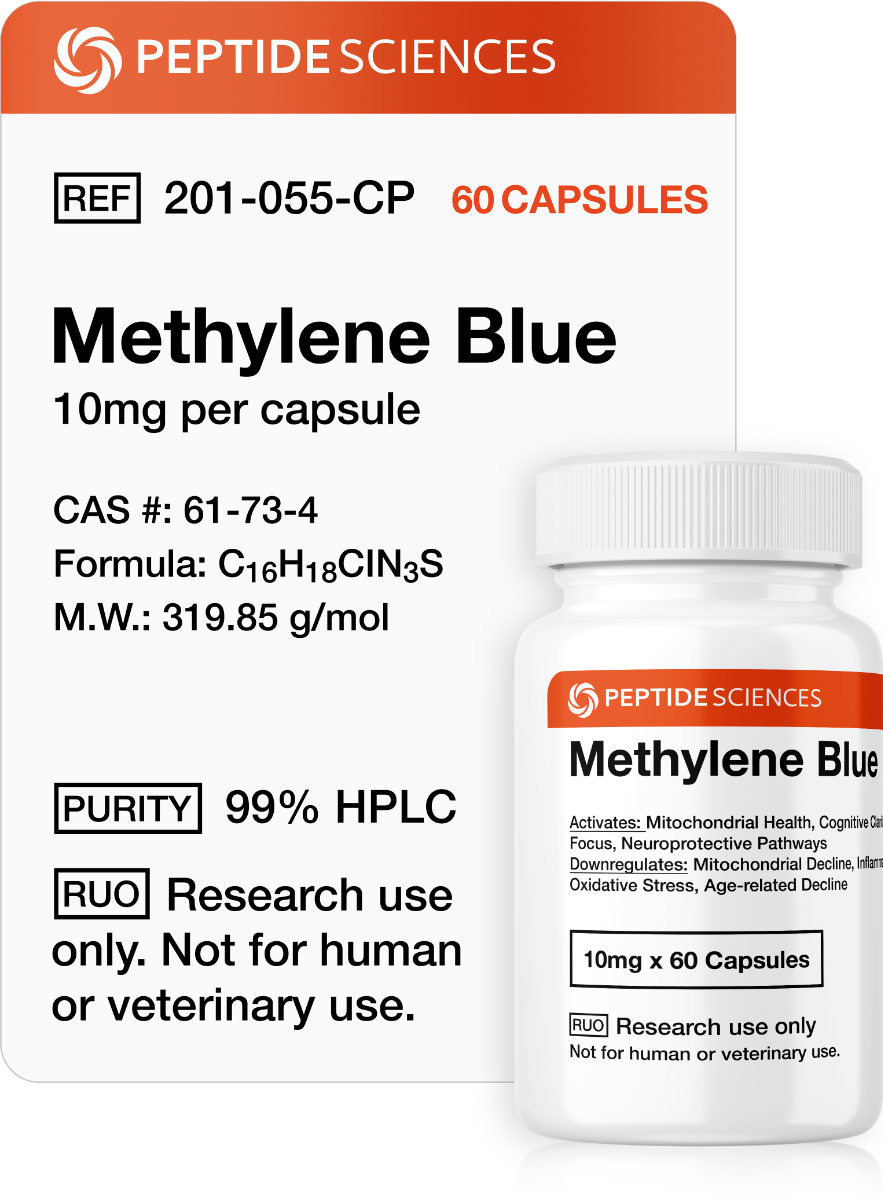
Methylene Blue (10mg x 60 Capsules = 600mg)
Methylene Blue is a well-studied redox-active compound, meaning it can both donate and accept electrons — a key function in cellular energy processes. This allows it to enhance mitochondrial function by supporting the electron transport chain, improving ATP production and reducing oxidative stress. Research shows it also modulates inflammatory pathways and protects mitochondrial integrity. Methylene Blue is studied for its neuroprotective, metabolic, and anti-aging properties, making it a promising compound for brain health and cellular resilience.
$100.00
Buy Methylene Blue 10mg Online in USA
Buy Methylene Blue Online in USA from the official peptide sciences shop. Whether you need to buy peptides for weight loss or advanced metabolic studies, we provide guaranteed 99% purity. Researchers can safely buy semaglutide online and buy tirzepatide peptides online through our platform. We offer the cheapest online GLP-1 reagents for your lab. When you need to buy GLP-1 online over the counter for in-vitro trials, choose us. To buy peptides online USA with uncompromising quality, trust Peptide Sciences Shop. Methylene Blue is the common name for methylthioninium chloride, a salt that has been historically used as a diagnostic agent, and as a therapeutic in limited circumstances. In the clinical setting, it is most frequently used to treat methemoglobinemia, a condition that can be caused by certain medications or because of certain genetic anomalies. It is additionally used to treat vasoplegic syndrome (redistributive shock), fosfamide-induced encephalopathy, and cyanide intoxication. In recent years, however, methylene blue has become of interest as a potential treatment for neuropsychiatric disorders such as biopolar disorder, Alzheimer’s disease, and schizophrenia.
Very recently, methylene blue has seen a resurgence of interest in research circles as a potential cognitive enhancer as well as an anti-aging compound. Research hints at the possibility of methylene blue improving metabolism as well. The exact explanation for how methylene blue works in each of these cases is not available. It is thought of primarily as an antioxidant, but that is not precisely its role. As is discussed later, methylene blue is probably best characterized by the benefits it has in mitochondria and the electron transport chain. Its antioxidant properties are almost a side effect of its main role as an electron acceptor.
Methylene blue is highly orally bioavailable (~73%) and is thus generally administered as an oral research agent. It quickly moves from the bloodstream into several key organs with the brain and liver being the most readily targeted.
Methylene Blue: Structure

Source: PubChem
Molecular Formula: C16H18CIN3S
Molecular Weight: 319.85 g/mol
PubChem CID: 6099
CAS No: 61-73-4
Synonyms: Basic blue 9, Solvent blue 8, Methylthioninium chloride, Chromoosmon, Swiss Blue, Tetramethylene blue, 3,7-bis(dimethylamino) phenothiazine chloride tetra methylthionine chloride
Methylene Blue: Research
Methylene Blue: What Is Methylene Blue?
Methylthioninium blue is an organic thiazine compound originally synthesized in 1876 for use as a textile dye. It is used as a stain in microscopy and as a clinical medicine began in 1890. It is highly soluble in both water and organic solvents, which makes it ideal for staining not just cells, the but the organelles within them. It was used early on as a treatment for malaria and was perhaps the earliest known antidepressant medication. It was not until much later that it was learned that methylene blue raises serotonin levels due to its monoamine oxidase inhibiting qualities. The salt was often added to other medications so that doctors could monitor patient compliance by simply observing the color of their urine. Methylene blue is primarily eliminated by the kidneys and imparts a stark blue color to the urine.
Methylene blue possesses multiple mechanisms of action. It inhibits guanyl cyclase, scavenges nitric oxide, modulates the nitric oxide-cyclic guanosine monophosphate signaling pathway, is a co-factor for NDAPH-dependent methemoglobin reductase where it reduces Fe3+ to Fe2+, and inhibits monoamine oxidase. These functions result in the following known uses of methylene blue.
- Vasoplegic syndrome – Vasodilatory shock can result from cardiopulmonary bypass procedures and leads to multiple organ failure without treatment. It results from the inflammatory release of vast amounts of nitric oxide (NO). Methylene blue inhibits the effects of NO and is generally given in this setting as two IV doses given at the onset of the condition and then again 22 hours later.
- Methemoglobinemia – Methemoglobinemia is a condition in which the iron contained within red blood cells is all in the oxidized Fe3+ state and thus cannot pick up and carry oxygen. It can be the result of certain medications, toxins (e.g. cyanide), or genetic conditions. By reducing Fe3+ to Fe2+, methylene blue restores the ability of red blood cells to carry oxygen.
- Neuroprotection – Methylene blue aids mitochondria in producing energy (ATP) even in the absence of oxygen. Cells require ATP to live and cells of the central nervous system use more ATP than just about any other cell in the body. Research shows that methylene blue can stimulate mitochondria to produce more ATP and is therefore of use in the setting of stroke, Alzheimer’s disease, Parkinson’s disease, optic neuropathy, and a multitude of other neurologic conditions.
- Anxiety and Depression – Methylene blue inhibits the activity of monoamine oxidase, the enzyme responsible for breaking down serotonin. Thus, methylene blue increases levels of serotonin as well as similar compounds like norepinephrine. It is thought that this activity accounts for some of the compound’s antidepressant and ant-anxiety properties, but research suggests it may have additional effects beyond this more obvious action.
- Cardiovascular protection – By inhibiting guanylate cyclase, methylene blue reduces the concentration of cyclic guanosine monophosphate (cGMP) and leads to vasodilation. This can be important in the setting of medication overdose in drugs like calcium channel blockers, amlodipine, and the inappropriate combination of metformin and ACE inhibitors.
- Covid-19 – Research shows that methylene blue can improve oxygenation in patients with severe COVID-19. This is especially true when combined with vitamin C, dextrose, and N-acetyl cysteine[1].
Methylene Blue: Methylene Blue and Aging
Mitochondrial dysfunction is one of the central hallmarks of aging. It has been linked to a wide array of age-related pathologies including metabolic syndrome, neurodegenerative disease, cardiovascular disease, cancer, and even deterioration of skin. Mitochondria play a central role in energy homeostasis and in the production of reactive oxygen species. The dysregulation of mitochondrial function has been linked to chronic inflammation, cell death, tissue senescence, and even cancer[2].

Overview of mitochondrial dysfunction as it relates to aging.
Source: PubChem
In cells, energy in the form of ATP is produced via electrons flowing down a concentration gradient. This gradient is established via an electron transport chain, which burns glucose in order to pump electrons from one side of the inner mitochondrial membrane to the other. This process is called oxidative phosphorylation and is the primary means by which energy is produced in cells.
In oxidative phosphorylation, oxygen serves as the final electron acceptor in the electron transport chain. Without oxygen, the machinery of the cells begins to malfunction and the results are two-fold. First, the amount of energy that a cell can produce is dramatically reduced and this can lead to cell dysfunction or even death. The second consequence is that cells revert to less efficient forms of energy production that produce higher levels of reactive oxygen species (ROS) leading to inflammation and tissue dysfunction. Thus, an adequate and constant supply of oxygen is necessary for mitochondria and therefore cells to function, grow, and remain healthy. The brain is a heavy user of oxygen. Even at rest, the brain uses 20% of the body’s glucose and 20% of its oxygen.
As it turns out, simply having an adequate supply of oxygen is not enough to stave off inflammation generated by mitochondria. As we age and our mitochondria become less efficient, the electron transport chain starts to back up. This means electrons do not flow through smoothly and can start to interact with oxygen before they get to the end of the chain. This also produces reactive oxygen species and degrades the ability of mitochondria to produce energy. This hallmark of aging may explain why energy levels wane with age and why inflammation becomes increasingly common. While there are mechanisms for dealing with this type of inflammation, they also start to wane with age and the inflammation starts to overwhelm the defenses against it.
Methylene blue can act as a final electron acceptor in the electron transport chain, thus taking the place of oxygen. In the setting of serious neurodegenerative conditions, where oxygen delivery to mitochondria is compromised, methylene blue can reduce oxidative distress and improve mitochondrial function. This, in turn, provides more energy to neurons and other energy-hungry cells of the central nervous system which, in turn, means that these cells have a higher survival rate.
Reviews