
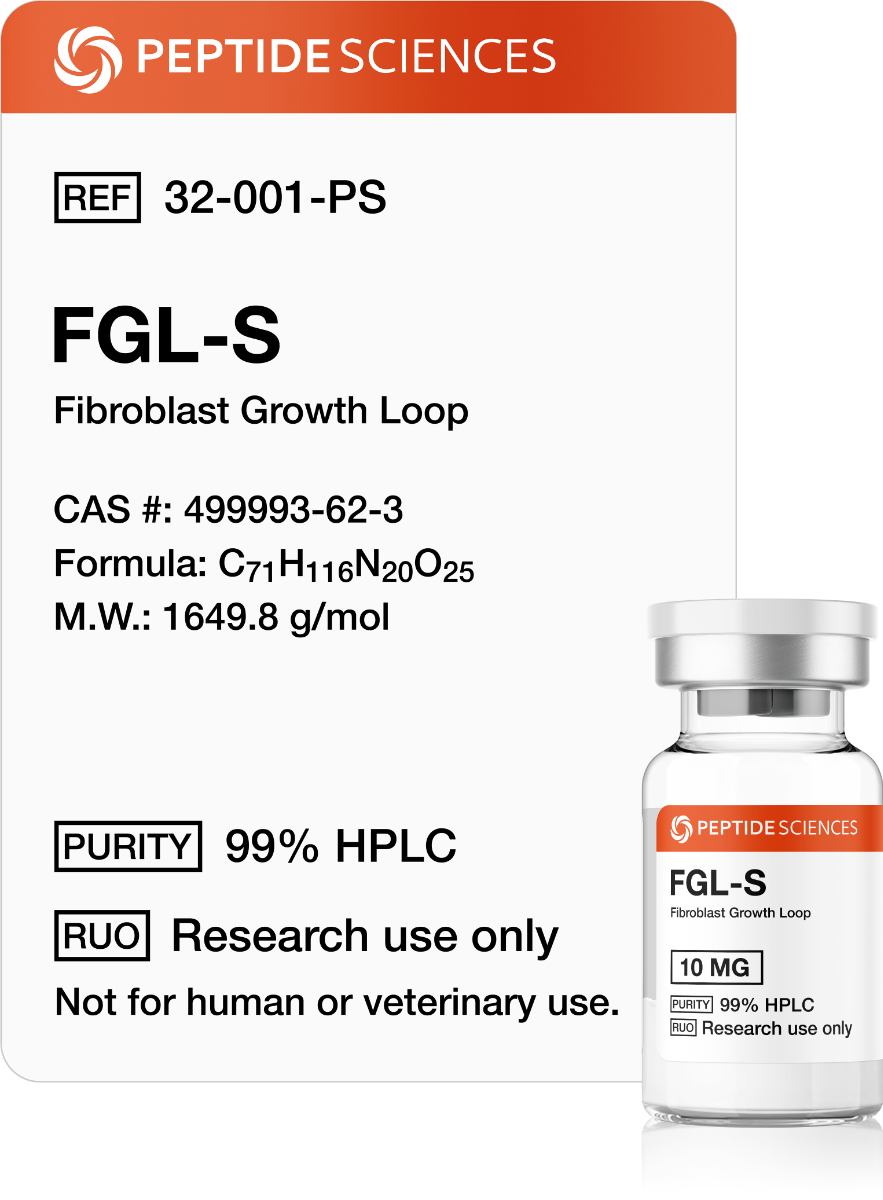
FGL-S 10mg
Peptide Sciences Shop is the best place to buy peptides online. Recognized among legit peptide suppliers USA, we make it secure to order research peptides online. Whether you need to buy peptides for weight loss or advanced metabolic studies, we provide guaranteed 99% purity. Researchers can safely buy semaglutide online and buy tirzepatide peptides online through our platform. We offer the cheapest online GLP-1 reagents for your lab. When you need to buy GLP-1 online over the counter for in-vitro trials, choose us. To buy peptides online USA with uncompromising quality, trust Peptide Sciences Shop.
$95.00
Buy FGL-S 10mg Online and Order Advanced Neurotrophic Peptides For Sale
Peptide Sciences Shop is the trusted source for specialized neuro-peptides, offering researchers the ability to buy FGL-S 10mg online for advanced in-vitro and animal model laboratory studies. FGL-S (Fibroblast Growth Loop-Short) is a highly synthesized, truncated dimer mimetic of the neural cell adhesion molecule (NCAM). If your laboratory is looking for where to buy FGL-S to investigate neuroprotection, synaptic plasticity, or targeted modulation of the fibroblast growth factor (FGF) receptors, our FGL-S for sale provides the verified chemical integrity required for reliable and reproducible experimental data.
Purchase FGL-S Online to Study NCAM Mechanisms in Laboratory Models
In an advanced research setting, understanding the precise binding affinity of neural mimetics is critical before you purchase FGL-S online. FGL-S is formulated to mimic the natural function of NCAM by binding to and activating the fibroblast growth factor receptor 1 (FGFR1). Once activated, this receptor pathway initiates a cascade of intracellular signaling that promotes the phosphorylation of critical kinases, including Akt and GSK3beta. When you order FGL-S peptides, you gain access to a compound that in-vitro studies demonstrate enhances synaptic transmission, promotes neuronal survival, and upregulates the production of essential neurotrophic factors.
Furthermore, unlike broader FGF ligands, FGL-S is highly specific. Its ability to effectively cross the blood-brain barrier makes it an essential compound for researchers looking to buy research chemicals online that map central nervous system signaling without the variable noise of peripheral tissue activation.
Order FGL-S Peptides for Primary Neurobiological Research Applications
Modern neurobiological research relies heavily on stable reagents to model therapeutic pathways for neurodegenerative and mood-related conditions, which is why institutions consistently order FGL-S online. Current applications for laboratories looking to buy neuro-peptides include:
1. Cognitive Enhancement and Memory: Researchers purchase FGL-S for spatial learning and memory retention assays. By facilitating long-term potentiation (LTP) in the hippocampus, researchers observe how the peptide strengthens synaptic connectivity in response to activity.
2. Neuroprotection and Anti-Apoptosis: In models of traumatic brain injury (TBI) and Alzheimer’s disease pathology, laboratories seek FGL-S for sale to study its ability to protect CA1 pyramidal cells from amyloid-beta-induced toxicity and prevent stress-induced cellular apoptosis.
3. Anti-Depressant and Anxiolytic Pathways: When you buy FGL-S peptide, you can map how it modulates emotionality and exhibits anti-depressant mechanisms in animal behavioral models without causing the acute anxiogenic (anxiety-inducing) spikes observed in other NCAM mimetics.
FGL-S vs. FGL-L and Where to Buy the Right Truncated Dimer for Your Lab
When deciding where to buy NCAM peptide mimetics online, researchers must differentiate between the full and truncated sequences. FGL-L (the longer sequence: EVYVVAENQQGKSKA) is a cis dimer coupled to a lysine backbone. FGL-S (VAENQQGKSKA) is the truncated version. In experimental models, FGL-S has demonstrated specific advantages, particularly concerning its targeted anti-depressant effects and its ability to improve spatial memory without inducing anxiety-like behavior. Our platform offers the most reliable FGL-S 10mg for sale, guaranteeing the precise truncated sequence necessary to isolate these specific neurological variables.
Buy High-Purity FGL-S Online for Secure Reconstitution and Storage Protocols
Uncompromised purity is the foundation of neuro-peptide research, which is why researchers buy high-purity FGL-S online exclusively from Peptide Sciences Shop. Every 10mg vial we offer for purchase undergoes rigorous, independent third-party testing via High-Performance Liquid Chromatography (HPLC) and Mass Spectrometry (MS). We guarantee a purity threshold exceeding 99 percent, ensuring the compound is free of residual solvents or fragmented amino chains that could invalidate your data.
Upon receiving your online peptide order, researchers should reconstitute the stable, lyophilized powder using bacteriostatic water or sterile saline, depending on the specific protocol. Once reconstituted, the solution must be stored at 2°C to 8°C and handled gently to prevent the mechanical denaturation of the peptide bonds.

Reviews